Prologue
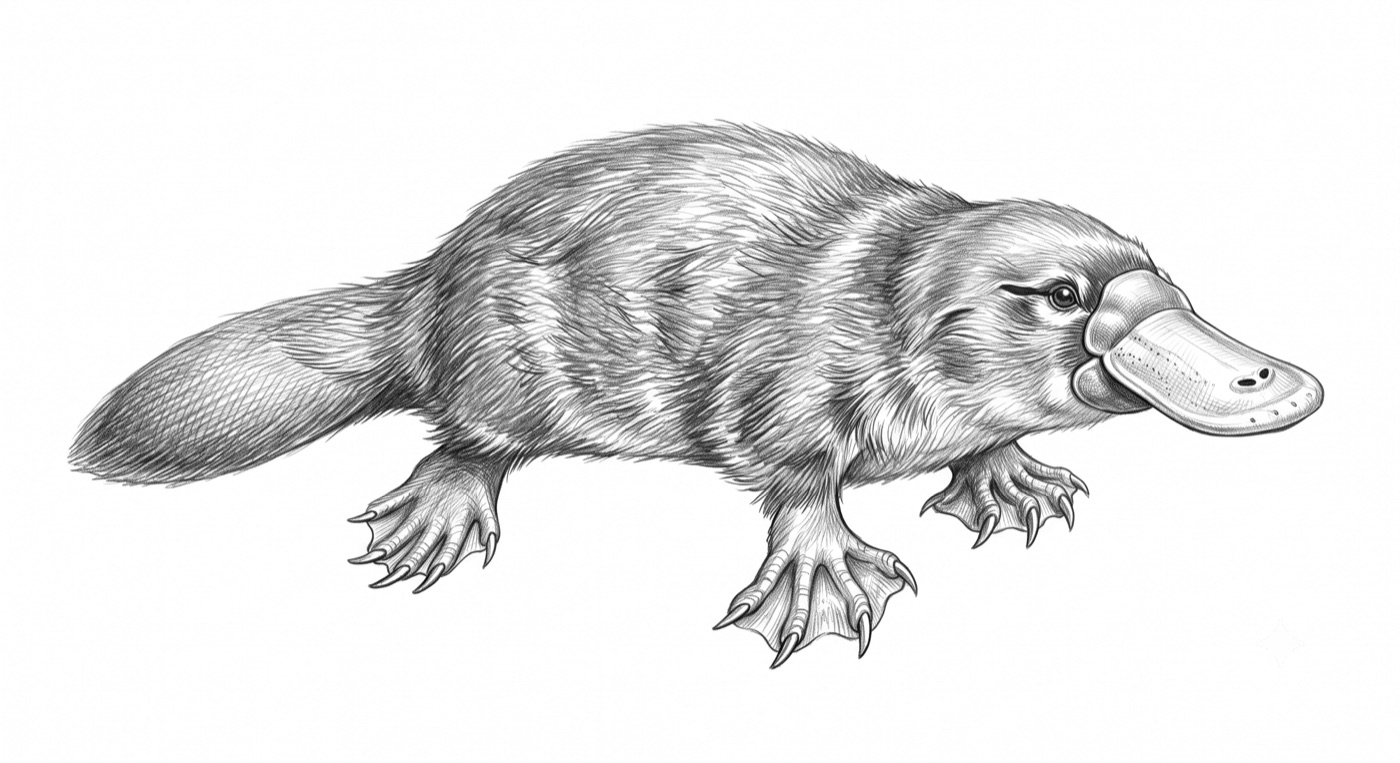
When Gracie came to the Works, the Registrar couldn’t decide what she was.
She had a bill like a duck and a tail like a beaver, fur like an otter, and feet webbed for the water and clawed for the earth. She laid eggs, which made her a bird. She fed her young on milk, which made her a beast. She carried a spur at her heel with a bead of poison in it, which made her a thing the ledger had no column for at all. The Registrar was an old crane who had kept the great ledger of the valley for forty seasons, and he had never once found it wanting. He ran his claw down the columns. Fowl. Fish. Beast of the field. Beast of the burrow. Not one line would hold her.
An animal who trusts his ledger more than his eyes will, when the two disagree, correct his eyes. The Registrar didn’t decide the ledger was too small. He decided Gracie was too strange. “Divergent,” he wrote at last, in the cramped hand he kept for exceptions, and he set her in the margin, and the word went with her after that. It wasn’t meant cruelly. She had simply been filed, and a thing that has been filed is easy to leave where it lies.
Gracie didn’t mind, at first. She had come to the Works believing the thing every young creature believes on the morning it arrives: that the water lifts whoever swims hardest. Do the finest work in the valley, and the valley will carry you to the front of it. She believed this the way she believed the river ran downhill. It seemed to her less an idea than a law, and she set about proving it the only way she knew, which was to be the best there was at the one thing she could do.
And what Gracie could do, no other animal at the Works could do at all.
She hunted with her eyes shut. She would seal her eyes and ears and nose, roll off the bank into the brown water, and go down into the dark where nothing could be seen, and there, in the mud, she read. Every living thing gives off a small trembling of its own, a whisper far too faint for eyes, and Gracie’s bill was made to feel it. A worm turning under six inches of silt. A crayfish holding still against a stone, certain it couldn’t be found. She found them all. She did her finest work blind, in the one place at the Works where no other animal could follow to watch her do it, and she was better at it than anything the valley could remember.
The trouble with being better than anyone at a thing no one can see is that no one can see it.
It was Gracie, and only Gracie, who felt the rot.
Deep at the foot of the King-Dam, the great dam the whole valley’s story was built on, something had begun to turn. A soft place in the anchor timbers, far down where the current pressed hardest, giving off the faint wrong whisper of wood going to pulp. She felt it a full year before it would ever show at the surface. She came up, and shook the water from her fur, and did the thing she believed a good animal does with a true and useful finding. She carried it to the gathering and laid it down in front of everyone.
She stood at the season’s assembly, before the whole Works, and she said it plainly. The King-Dam is rotting at the anchor. I have felt it. It will not hold another two floods.
The dam had been built by Castor, the finest dam-wright in the valley, and Castor was sitting in the first rank with his broad tail folded under him. Every head turned from Gracie to Castor and back again. Castor said, mildly, that he had inspected the anchor himself in the spring and found it sound, and that he’d of course be glad to learn how a creature who had never set a single timber had come to know his own dam better than he did. There was a small laugh, the kind that isn’t really about anything funny. The Heron who led the Council inclined her long gray head and said the matter would be looked into, and then the assembly moved on to the fish counts.
Gracie had read the water perfectly. She had read the gathering not at all. She sat back down without yet understanding that those were two different skills, and that she had just been marked hard on the second while being exactly right about the first.
At the Turn of the season, the Council named those who would stand at the head of the water.
This was the whole of the visible scoreboard, the thing every animal at the Works spent the year swimming toward. To stand at the head of the water was to be seen to have risen: the good bank, the first pick of the run, the right to be called upon when it mattered. Everyone believed it went by the season’s work, because that was what the Council said it went by, and because believing it was a great deal more comfortable than the alternative. (It always is.)
Gracie had done the finest work of anyone. She was sure of it, and she wasn’t wrong. So she wasn’t ready, at the Turn, to hear the Heron name Sorrel the otter to the head of the water.
Sorrel was quick and bright and easy, and he had spent the season where the otters always spent it, in plain sight at the top of the run, calling the fish counts in his carrying voice, first to arrive at every gathering and last to leave it. He had done good work. He hadn’t done Gracie’s work. No one had. But when the Council closed itself away to decide, Sorrel was a name the deciders already had in their mouths, and Gracie’s name came into a silence, because the only proof of what Gracie did lay at the bottom of the river in the dark where none of them had ever been.
There was nothing wrong with Sorrel. That was the part Gracie couldn’t make sense of. He hadn’t schemed. He had simply been where he could be seen, doing work of a kind that could be seen, in a shape the valley already knew how to praise. The current had carried him and it had left her, and neither of them had felt it happen.
She went down to the water that night and floated on her back under the moon and tried to make the arithmetic come out. Best work, passed over. Lesser work, lifted. It wouldn’t resolve. She lay there feeling every current in the river move against her fur, the cold thread off the north bank, the warm slack behind the stone, the long pull of the deep channel, every current in the whole river except the one that had just decided her entire season, because that current ran somewhere her bill had never been taught to feel.
“You feel all of them but the one that matters,” said a low voice from the bank. “I used to lie in the water like that too.”
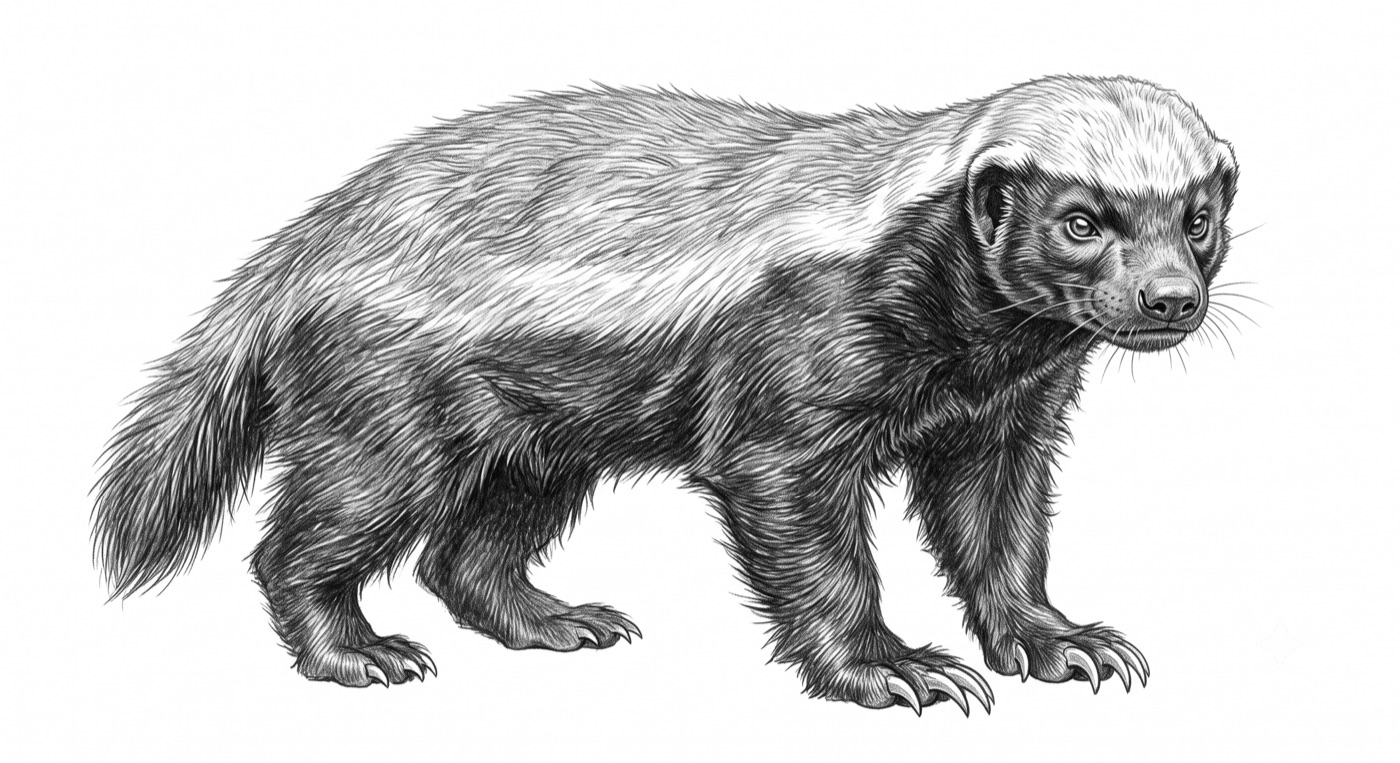
The voice belonged to a honey badger.
He was old, and he was a ruin to look at. One ear was gone to a notch. His hide hung loose and gray across his shoulders as though it had been cut for a larger animal, and it was crossed everywhere with the pale seams of old wounds. He sat on the bank with his short legs stuck out in front of him, watching her with small black eyes that didn’t seem impressed by anything they had ever seen.
His name was Dorn, and Gracie knew of him the way everyone knew of him, which was as a problem. He worked the boundary alone, the dangerous, unglamorous edge of the Works where the wild things came in the night. He had been driven off twice for insolence, and twice the Council had quietly asked him back, because when something came out of the dark toward the young ones, Dorn was the only animal at the Works who walked toward it instead of away. He was difficult and he was necessary, and he had made a hard peace with being kept for what he could do and resented for what he was.
“There are two rivers,” Dorn said. “You have spent a whole year swimming the one you can see. Fastest, cleanest, hardest. And you have been beaten by animals swimming the other river, the one you could not see, the one that decides where a creature comes out. You can’t feel that current. Neither could I. Some are born already knowing how it runs, and they never once have to think about it. We are not those animals. We chart it by hand, a wound at a time.”
“The rot was real,” Gracie said. “I felt it. I told them.”
“I know you did. I heard you tell them.” Dorn scratched himself without hurry. “And when your rot finally shows, a flood or two from now, and the anchor goes soft the way you said it would, do you know whom the valley will remember as the one who saw it coming? Castor. Because Castor will stand up at the assembly and say he’d kept his eye on that anchor for years, and he’ll believe it while he’s saying it, and there’ll be no one to tell it otherwise, because your knowing lives at the bottom of the river where it can’t speak for itself. Your work doesn’t speak, little egg-layer. It never has. Somebody carries it up into the light, or it drowns down there in the dark with you.”
Gracie was quiet a while. Then she asked the question that had been under all of it. “The place where they decided. Where is it?”
“The reed-lodge, up the bank, where the Council shuts itself away.” Dorn tilted his notched ear toward it. “And you’ll want to know why you weren’t in it. You weren’t in it because you are never in it. None of us are. That’s the whole trick of the place. The lodge where your name gets spoken is the one lodge you’ll never be let into, and everything that decides you happens inside it, and all you’ll ever get is the result walking back out the door with somebody else’s name on it.”
He looked at her a long moment.
“I can tell you how the current runs. I’ve been telling you these last few minutes. But knowing the current and swimming it aren’t the same, and I can’t swim it for you.”
Dorn taught her through the winter, in the way a honey badger teaches, which is mostly by being asked and answering shorter than you’d like.
He taught her that the Works ran on a story, and that the story had begun to drift. The story was this: we are the great dam-builders, and the valley needs our dams. It had been true for a long time. But the rains had changed. They came harder now, and in the wrong season, and what the valley was starting to need was not another wall thrown across the water but someone who could feel the sickness moving through the channels and clear it before it choked them. Gracie could feel that turning in the river the way she’d felt the rot. The Council couldn’t. The Council went on building dams, because a dam was the thing the Works knew how to be proud of, and the story a place tells about itself is the very last thing it will let you take away from it.
She tried to say it once, at a gathering, the way Dorn had warned her not to. She said the valley was changing and the dams were becoming the wrong answer. The Heron listened with her patient gray stillness and said it was a thought worth returning to, and that Gracie should bring it to the Council in the spring, when there would be time to give it the attention it deserved. Spring came. There was no time. The thought was returned to once more, and then it wasn’t returned to again, and no one had ever said no to it, which Gracie came slowly to understand was itself the answer. A thing that is never refused and never done has been refused in the only way the Works knows how.
“They’ll never say no to you,” Dorn told her. “Saying no would mean setting down a rule they’d then have to keep. So they nod, and they thank you, and they let it die of waiting. If you want a thing decided at the Works, you don’t decide it at the gathering. The gathering is where they announce what got settled somewhere else. You settle it first, in the small quiet places, one animal at a time, before anyone sits down in a circle at all. You learn what each of them needs before they have to ask for it in front of the others. And you read the season, because the same true thing that lifts you in a fat year will sink you in a lean one. A lean one is coming. I can smell it on the water. The Council has gone quiet the way they always go quiet just before they start taking things away.”
So Gracie set out to swim the other current, and at first she was as bad at it as she had once been good at the mud.
She chose a young otter named Pel, who sat near the back at gatherings and seemed friendlier than the rest, and one gray afternoon she caught him alone on the bank and told him everything. The drift in the river. The rot. The dams that were becoming the wrong answer. She laid it out clean and complete, the way she’d lay a finding at the bottom of a dive, and waited for him to see it as plainly as she did.
He didn’t. He shifted from foot to foot, said it was very interesting, and got back to the run. And then, because she’d handed him a heavy strange thing and given him nowhere to set it down, he did the only thing an animal does with a trouble he can’t use. He carried it off and repeated it. By the time it had crossed the bank twice it was a story that the strange filed-away creature was going about saying Castor’s dams were rotten and the Council were fools, and it reached Castor before it reached anyone who could have used it, and it cost her a friend she hadn’t finished making.
“You didn’t bring him in,” Dorn said, when she came to him stinging. “You dropped your trouble on a young otter in a quiet spot and called that working the current. Bring an animal in, and he’ll defend the thing as if he thought of it, because in part he did. Drop it on him, and you’ve handed him one more trouble to set down, and he’ll set it down wherever it costs him least, which is on you.” He let that sit. “You’ll get it wrong a good many more times. I did, for years. Go slower. Win one animal all the way before you reach for two.”
The lean year came the way Dorn said it would, and the first thing it took was Dorn.
In a fat year the Council could carry a difficult old badger at the boundary the way a full river carries a heavy log, without seeming to feel the weight. But the water dropped, and a difficult animal is always the easiest weight to name. He was insolent, they said, which was true. The dark had been quiet a few seasons, and a boundary-keeper is a cost you resent paying right up until the night you can’t do without him. So they cut him, and thanked him for his long service in the flat voice a place uses when it settled the thing a while ago and is only saying it aloud to be finished with it.
Dorn took it the way he took everything, without appearing to take it at all. What surprised Gracie was how far the ground went out from under her own feet. She hadn’t understood, until he was gone, how much of her small standing was really his. The Works had granted her a sliver of attention, not because they could see her work, but because the old badger they trusted about the dark had plainly decided she was worth his time. Now that stopped. Her next finding fell into the old silence, deeper than before.
She found him past the boundary, digging, which is what honey badgers do when they’ve nowhere in particular to be.
“You built on me,” he said, before she could speak. “My fault as much as yours. I let you.” He didn’t stop digging. “A sponsor is a season, not a fixture. We move, we get old, we get cut in a lean year by a Council counting logs. Build wider than one. The otter who owes you a fair turn. The young beaver you helped when no one was watching. Not because three is a magic number, but so that when one of them moves you’re not left in the open with your whole self resting on an animal who isn’t there.” He looked up, his one good ear turned toward her. “Start now, while it’s quiet. It’s too late to dig the burrow in the storm.”
So Gracie began the slow unglamorous work she should have begun a year before. She learned what a water-vole named Reed was afraid of, and what a young beaver named Whitethroat wanted that no one had thought to ask. She built more than one thread of her own, and none of it showed, and all of it was the only kind of work that would hold when the water came.
The water came in the spring, hard and brown and out of its season.
One gray morning Gracie went down to the foot of the King-Dam and felt, through her bill, the thing she had warned of two years before finally beginning to let go. The anchor was going. Not in a season. In a day, perhaps two. If it went, the King-Dam would go with it, and the low burrows where the young ones wintered would be under the flood before any of them woke.
She knew exactly what had to be done. The near channels had to be cut open to bleed the pressure off the anchor, and cut within a few hours, and she was the only animal alive who could feel where the water wanted to go. She knew the fix the way she knew her own name. And she had no standing to order a single stick moved. She was divergent, unvouched-for, working in a place no one could see at a thing no one could check. If she surfaced now and told the Works to tear open its own channels on the word of an egg-laying creature the ledger couldn’t classify, they’d do to her what they had done at the assembly, except this time the water would not wait for them to finish laughing.
But she wasn’t, this time, resting her whole self on one animal who wasn’t there. She had Reed the water-vole, who had spent the winter being listened to by her and owed her a fair turn. She had Whitethroat the young beaver, who had wanted to matter and been given the chance. She sent Reed running for the Heron, the plain hard choice already in his mouth, framed the way she had learned to frame it. She set Whitethroat to gathering the strongest of the dam-wrights to the near channels, ready to cut on her word. It wasn’t enough on its own, and she knew it. Her own threads were young and thin. She needed one more, and the one she needed was the one she had lost.
She found Dorn past the boundary, and she did the thing she had never once done, which was to ask him plainly for his help.
He was already getting up before she had finished. “I’ve been cut, egg-layer. I’ve no seat in that lodge anymore.” He shook the dirt from his loose gray hide. “But I’ve one coin left, and a coin is no good to a dead badger, and I’ve been saving it a long time for something.” He went up the bank at his short rolling run, toward the reed-lodge he’d been thrown out of, into the one place Gracie still couldn’t go, to spend the last of what he had.
They tried to turn him back at the lodge, and he went in anyway, the way he went toward everything, and he stood in front of the Council that had cut him and told them he had watched the platypus work the mud since the day she arrived, that she read what none of them could read, that she had called this rot two years ago to their faces and they had laughed, and that if the Heron trusted one single thing Dorn had ever said in thirty difficult years, she should trust him now and let the strange one open the channels. He had no proof to give them. He had only himself, cut and scarred and standing in a lodge he’d been barred from, laying his last coin on the table beside a name that wasn’t his own.
It’s the most a sponsor can ever do. It’s more than most will ever do, and far more than any animal owes to one who can’t pay it back.
Because Dorn had gone into the lodge first, and because Reed had reached the Heron ahead of the panic with the choice laid out clean, the deciders were ready when Gracie came up out of the water.
The Heron met her on the bank with the flood climbing behind them, and this time Gracie didn’t do what she had done at the assembly two years before. She didn’t stand up and drop the whole alarming truth flat on the ground for the Council to trip over. She had learned, at the cost of a friend and a season and a good deal of her pride, that getting the lodge to hear you and getting it to move aren’t the same, and that she had a gift for making a lodge feel struck and had mistaken it, her whole life, for the other thing. So she laid it out as a choice, cleanly, the way you set two stones in front of someone and let them lift the one they mean to keep.
“We can open the near channels now and lose the low meadow, which will flood and be ugly and grow back green by summer,” she said. “Or we can leave them shut and keep the meadow one more day, and lose the King-Dam, and the winter burrows under it. It’s one or the other. It’s yours to say, and I’ll show whoever you send exactly where to cut. But it has to be within the hour.”
She hadn’t softened the truth by a hair. She still carried at her heel the spur with its bead of poison, and she had never once driven it into anyone, because she had learned there are better ways to make a lodge feel a thing than to wound it. She had only changed the shape of the truth, from a thing that made a lodge defend itself into a thing a lodge could pick up and act on. The Heron looked at the water a long moment with her still gray patience, and then she said, “Open the channels, and do exactly what the platypus tells you.”
They cut the near channels where Gracie showed them, and Whitethroat and the dam-wrights worked them wide, and the brown water found the path she had felt it wanting all along, and it poured off into the low meadow and made an ugly shallow lake there, and the pressure came off the anchor, and the King-Dam held. The valley woke that morning to a flooded meadow and never knew, most of it never knew, how near it had come to waking to nothing at all.
It cost her, in the way these things always cost. Castor couldn’t forgive that the rot had been real, that the strange filed-away creature had been right in front of everyone about his own dam, and he saw to it, in the small quiet places she had finally learned existed, that the drowning of the meadow was told as her recklessness before it could ever be told as her saving of them. Some of it stuck. Some of it always sticks. Gracie felt the bite of that, and it was a true bite, the kind that would have finished an animal built entirely out of wanting to be liked.
But Dorn had taught her the last thing about his own kind, and it wasn’t the part everyone thinks they know. The honey badger’s gift was never that it didn’t care. It was the loose gray hide, cut large, that let it turn clean around inside its own skin when something bigger got a grip, so that you could never hold it by holding it. And it was the other thing, the thing the wild ones knew and gave way to: that a honey badger will take a bite that should have finished it, and go down, and lie still, and then get up, and come on again. Gracie took Castor’s bite, and turned inside it, and got back up. She had saved the burrows. She could carry being blamed for a meadow. Those weren’t the same ledger, and she had stopped keeping them on the same page.
What no one saw was how tired she was.
The mud-work had never tired her. She could read the dark river all day and come up hungry and glad. What drained her was the other current, the one she had spent two hard years learning to swim by main force because she hadn’t been born knowing it: the reading of the lodge, the settling of things in advance, the winning of one animal all the way before reaching for two, the shaping of a hard truth into a thing that could be taken in, the endless watching of animals for what they wanted and wouldn’t say. Every stroke of it went against her grain, and it cost her, in a coin the Works had no name for and would never have thought to enter in any ledger.
Dorn found her low one evening afterward, and named it for her, because he had been paying the same price for thirty years.
“The gift is free,” he said. “You were born reading the mud. That one costs you nothing. You’d do it for no one and be glad. But this other game is not free for you, and it never will be. Every hour you spend swimming the current you weren’t built for takes something out of you the mud-work never did. That isn’t weakness. It’s the price the Works charges you for swimming both currents, and you don’t get to pretend it isn’t being paid. What you get to do is know what it costs, and pay it on purpose, and keep for yourself a still dark pool to go down into afterward, and guard it the way you’d guard a nest with an egg in it.” He looked out at the water. “It doesn’t get fair. I’ll tell you that plainly, since no one told me. The river will not turn kind because you finally learned to read it. All that changes is that you stop lying in the shallows waiting to feel a current that is never going to reach your bill. You know it’s there now. So you stop waiting. You swim anyway.”
Dorn didn’t last many more winters. He had spent himself hard, and he went the way he’d have chosen, walking toward something in the dark instead of away from it. The Works resented him to the end and couldn’t have done without him, two things it had never once managed to feel apart.
Gracie took the boundary after him, and kept the deep mud too, and in time she became the strange old one the young animals were warned about and drawn to at once.
And one spring a new creature came to the Works, and the Registrar, a younger crane now but schooled in the same careful trust of the same ledger, ran his claw down the columns and couldn’t find the line. It was an echidna, a small spiny thing named Quill, who also laid eggs and also fed her young on milk and fit nowhere the ledger could hold. “Divergent,” the Registrar wrote, and set her in the margin. Quill didn’t mind at first, because she had come believing the water lifts whoever swims hardest, and she had a gift no other animal at the Works had, and she was certain that would be enough.
Gracie watched her through the season from the boundary. She watched Quill do the finest quiet work in the valley in a place no one thought to look. She watched her carry a true and useful finding into a gathering and lay it flat on the ground and stand there while it landed wrong, and not understand why. She watched the mark go on her that Quill couldn’t yet see.
And at the Turn, when Quill was passed over and went down to the water to float on her back and try to make the arithmetic come out, Gracie came and sat on the bank beside her, with her old scarred body and the look of an animal who had survived both rivers.
“You feel all of them but the one that matters,” she said. “I used to lie in the water like that too.”
“There are two rivers,” she told the young one. “You have been swimming the one you can see. The other is still there, and you’ll never feel it the way the born-knowing ones do. But you can chart it by hand, a wound at a time. I’ll show you the lodge you’re never allowed into. And one day, when it matters, I’ll walk into it myself and lay my old name on the table next to yours, because someone once did that for me.”
She let the young echidna sit with it a while, the way you have to.
Then she said, “Welcome to the Works.”
This fable opens Hacking the Scoreboard. The twenty chapters that follow it take everything Gracie learned a wound at a time and lay it out in plain language, for the workplace you already know. The book publishes September 2026. Leave your email and you’ll get one message when it’s out.